
The Loch Ness Monster has been one of Scotland’s most beloved icons for nearly a century, but stories of monsters in lochs go back thousands of years. Centuries of folklore combined with an international sensation created one of the world’s biggest mysteries.
Loch Ness is a 23 mile long, 755 foot deep freshwater lake. It has run through the Scottish Highlands for about 10,000 years, and some microinvertibrate species have been in the loch since the ice age. No light penetrates the bottom, and it is generally quite murky. There are various wrecks at the bottom of the loch, some of which have turned up in sonar scanning.
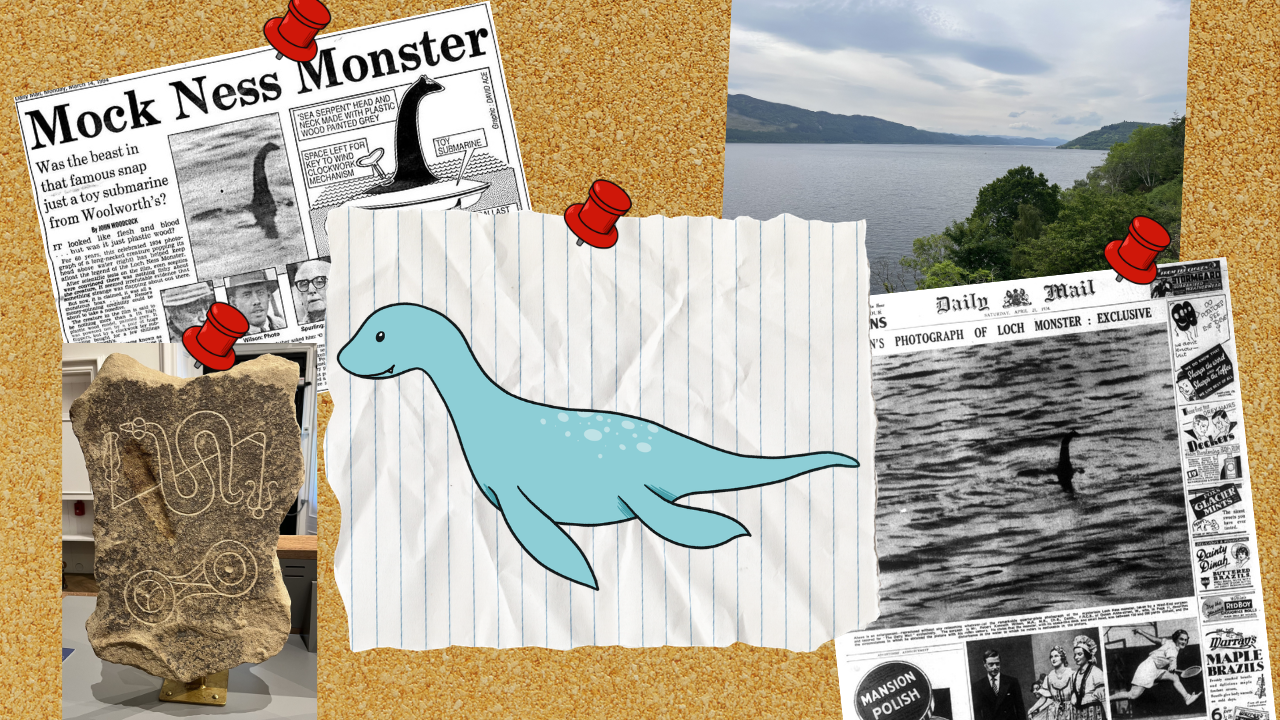
Since before recorded history, Scottish peoples have had rich mythologies involving creatures who resided in the natural world. The water held many dangers, including supernatural creatures who would lure or drag unsuspecting victims into the water to drown. Archaeologists have found picts from 500-600 AD of an unknown serpentine monster near the Loch Ness area. Early stories of Christianity in Scotland and Ireland include accounts of saints who tamed beasts in various lochs. In fact, the Irish Saint Columba was reported to have battled a monster in Loch Ness. In the 1930s, one woman would find that the loch was not as empty of monsters as she thought.
In April 1933, Mrs. Aldie Mackay, a manageress at the Drumnadrochit Hotel, spotted something unusual in the Loch. She claimed that there was a “whale-like fish” in the Loch and she witnessed it swim in a circle and back under the water. This sighting sparked the first Loch Ness media frenzy. Tourists came from all over the world to see what would be dubbed the Loch Ness Monster. There were various stories and sightings, and eventually, the general consensus on the shape of the beast was that of a plesiosaur. Plesiosaurs are ancient (currently extinct) marine reptiles that lived in oceans starting around the Triassic Period. The large body and long neck fit the description of many Loch Ness sightings.
The Daily Mail sent Marmaduke Wetherell, a game hunter from England, to find the Loch Ness Monster. He reported back saying that he had found some large footprints, but eventually zoologists from the Natural History Museum discovered that the prints were made from hippopotamus feet attached to an ashtray or umbrella stand. This was only one of the Daily Mail’s hoax encounters. In April of 1934, Robert Kenneth Wilson submittted the now iconic “Surgeon’s Photo” of the Loch Ness Monster. Only on his deathbed did he reveal the photo was fake, taken up close to a submersible made to look like the creature. The photo remains one of the most well-known images of the monster to date.
As sightings and speculation continued, various people tried their hand at finding the Loch Ness Monster. Several submersibles were launched from the 1960s to now. Scientists and experts have used sonar, deep soil samples, recordings, and various other methods to try and find the famous “Nessie”. People still explore the lake today, trying to find any sign of the monster. Loch Ness is one of the most well-explored lakes in the world due to its monster, who has still not been found.
So, what is the Loch Ness Monster? A few have posited that shipwrecks, particularly Viking ships, have prow decorations or warped debris which might make people assume they have seen a monster. Water birds, seals, and various fish have been suggested as monster material. Perhaps Plesiosaur still lives, say some. Until recently, it was thought that Plesiosaur only lived in saltwater, but scientists have recently discovered they lived in freshwater environments as well, bringing the theory back into mild popularity. Mini or model boats could (and have) been mistaken for a strange creature. Ultimately, there are plenty of living and inanimate explanations for this large loch lurker.
There is a great love of Nessie in the Scottish culture, and she has become a huge tourist pull. Nessie gets decked out in kilts, the Scottish flag, and has become somewhat of a hometown hero in the area. While many do not believe in her existence, there are just as many who want to believe. The Loch Ness monster has inspired skeptics and believers alike to investigate Loch Ness and discover its secrets, leading to greater understanding of the environment and helping to protect the loch.
Check out this Loch Ness sighting from 2016. What do you think about this photo? Are there any other animals that could account for the sighting?
For more Loch Ness resources, compiled by Adrian Shine, click here
The rest of my sources for this article can be found here!
