
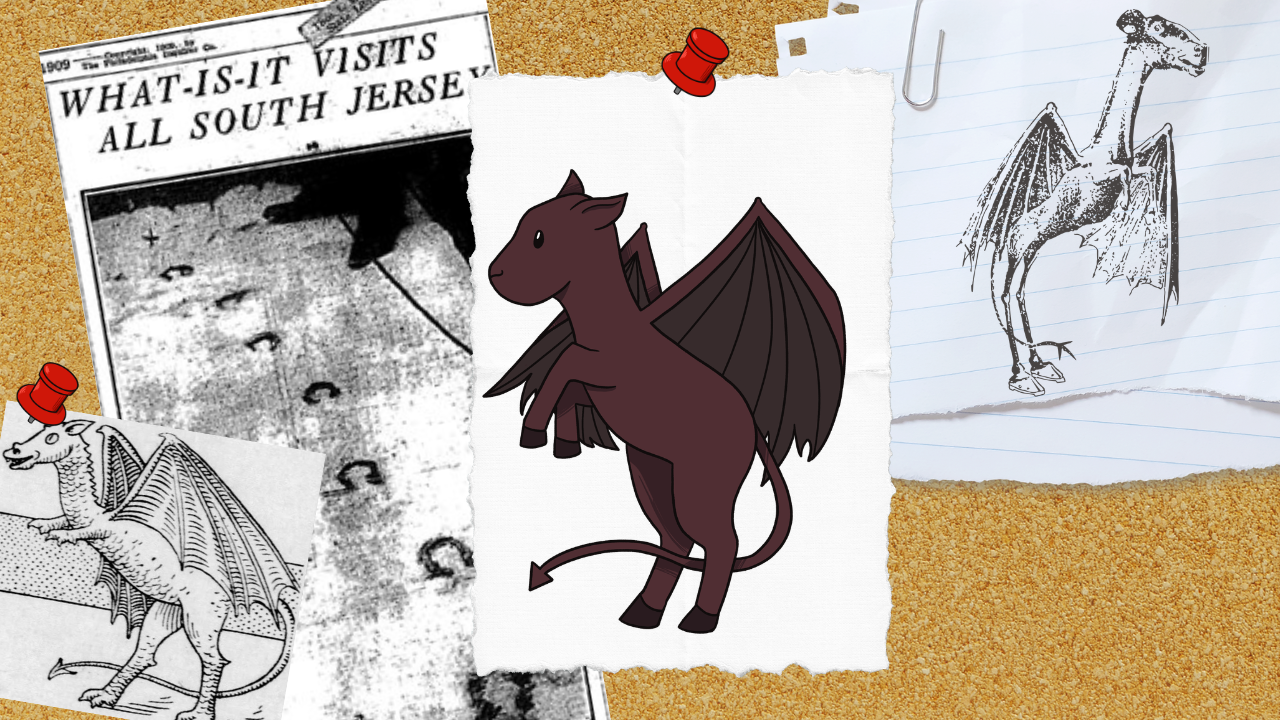
You may know that states in the U.S. have state flowers, animals, and foods, but did you know that New Jersey boasts the only state devil? Lurking through the Pinelands, the Jersey Devil has spread fear for nearly 300 years. How did the Jersey Devil come to be, and what is its legacy today?
There are many variations on the Jersey Devil’s story, but all center on the Leeds family in colonial America (on land that would later be called Leed’s Point). The most common telling is that the mother of the Leeds family already had 12 children and when she learned she was pregnant again, she declared, “Let it be the devil!” When she finally gave birth, her child grew hooves and scurried up the chimney. However, there is a very different story that may explain the Jersey Devil’s origin.
Daniel Leeds, a converted Quaker immigrant from England, was the creator of one of many Almanacs published in the American colonies. Almanacs were a valuable part of 17th century life because they contained information such as times to plant crops, weather forecasts, and other important dates. Leeds’ almanac was unique because it contained astrology, which many people thought to be too occult and pagan. Leeds would decide to leave Quakerism because of the Friends’ distaste for his astrology and their insistence on his public apology. Leeds leaned toward support of English royalty. This did not earn him support from groups who had escaped persecution from the crown by immigrating to the colonies. His relationship continued to sour with the Society of Friends, to the point where both he and they were writing libelous pamphlets about the other. Many of the pamphlets against Daniel Leeds painted him as working with the devil – maybe one of the reasons this family is now associated with this cryptid.
When Daniel Leeds retired after 29 years, he turned the venture over to his son, Titan Leeds. The younger Leeds included the draconic Leeds family crest, which some believe inspired the Jersey Devil’s look. As Titan Leeds continued his almanac, a new and upcoming competitor decided to create a true rivalry. The Poor Richard’s Almanac, written by Benjamin Franklin, began in 1732. Franklin decided to give the Leeds Almanac a taste of its own medicine by using astrology to predict Titan Leeds’ death on October 17, 1733. Titan Leeds did not die, but he was upset about this and said as much in his next almanac. Franklin responded in mock hurt, but asserted that it could not be Leeds speaking to him, since he had died in the previous year. Titan Leeds would die in 1738, and his legacy became a ghostly one. Interesting enough, the Jersey Devil’s “birth” coincides around the time of the death of Titan Leeds.
According to lore, the Jersey Devil inhabits the Pinelands and scares humans away with its “grotesque” appearance. Some say the Jersey Devil looks like a little devil man, but others claim the Jersey Devil is a dragon-like creature with hooves. The given reason for why there are variations of its form is because people are so frightened they cannot look at it for long. According to those who have heard the Jersey Devil’s cry, it has either a loud shriek or raspy whisper that strikes fear into the heart of those who hear it. If you live near the Pine Barrens, your chickens might go missing or you may have a devilish visitor in your trash. In older times, there were claims that it peeked in people’s windows, spoiled their milk, and gave them bad luck. Sightings of the Jersey Devil have occurred since the 1800s, and in 1909 the Devil went on a rampage through New Jersey and Pennsylvania. Since the 1960s, the rate of reports has dropped significantly.
Many have tried to capitalize on the Jersey Devil, sharing stories of sightings and attempting replicas. In 1911, one group in Philadelphia tried their best to revive their failing museum by advertising the capture of the Jersey Devil. “CAUGHT!!! AND HERE!!! ALIVE!!!” declared the poster, complete with a now-famous drawing of the creature. A New Jersey farmer had captured it, and now it was on display, right in Philadelphia! Unfortunately, when eager visitors came to see the Jersey Devil, all that they found was a kangaroo with some wings attached. Needless to say, the museum sold the location soon after.
So, what is the Jersey Devil? Skeptics believe that the Jersey Devil is just a folktale, a boogeyman with no real proof. The rumored cry of a Jersey Devil could be attributed to a fox, which is known for its eerie shrieking. There has been speculation that what people see is an owl carrying off its prey, or perhaps a migratory bird off its course. One news article even suspected that the Jersey Devil is a bald squirrel.
Regardless of its true nature, many people in New Jersey love their cryptid and bring it into their culture. The New Jersey hockey team’s name is the Jersey Devils. It is also the mascot of the Pinelands Alliance, a nonprofit organization dedicated to protecting the Pinelands. New Jerseyan Bruce Springsteen wrote a blues ballad in the voice of the Jersey Devil as a Halloween treat. Even outsiders love the devilish cryptid: while researching, I stumbled across a coffee company in Georgia that sells coffee based on cryptids including – you guessed it – the Jersey Devil. While still feared by some, the Jersey Devil has become a beloved staple in New Jersey folklore and culture.
Check out this relatively recent photograph of the Jersey Devil! Do you think it is real? What can you infer from the article’s tone?
If you’d like to read some historic newspaper articles, click here
If you are interested in Jersey Devil sighting accounts, click here
The rest of my sources for this article can be found here!

It isn’t easy being the Jersey Devil, especially when you’re a kangaroo.